
Vendor Central Overstock Returns, How to Reduce Risk Before the PO Is Even Accepted
Overstock returns are not only an Amazon returns issue. For vendors, they should be considered before pricing, product selection and supply decisions are made.
Listen to article
Overstock returns can quietly damage Vendor Central profitability when brands look only at purchase order value and sales. The initial number can look attractive. Amazon places an order, the stock leaves the warehouse and the channel appears to be moving.
If Amazon returns overstock, raises deductions or creates chargebacks, the real commercial value can change quickly. A product that looked profitable at the point of order may be much less attractive once the full Vendor Central cost is understood.
For vendors, overstock returns should not sit only with the returns team. They should be considered before the product is offered to Amazon, before cost prices are agreed and before purchase orders are accepted.
Why Overstock Returns Are a Commercial Issue
Amazon purchase orders can create a false sense of success. A brand may see regular demand from Vendor Central and assume the product is performing well because Amazon continues to order it.
The important question is not only whether Amazon buys the stock. The more useful question is whether the product remains profitable after returns, deductions, freight, handling and chargebacks are included.
A SKU can receive strong purchase order value and still become commercially weak if overstock returns come back at scale or each supply cycle creates operational friction. Finance may see the deduction while the commercial team continues accepting similar orders because the pattern has not been reviewed properly.
Overstock returns need senior attention because they can show where Amazon demand, product suitability and vendor margin are not aligned.
Cost Prices Need to Include Amazon Reality
Amazon cost prices should not automatically be set like standard wholesale prices. Vendor Central is a different trading environment, with different cost pressures and a higher level of operational scrutiny.
For a conventional wholesale customer, a vendor may price around volume, payment terms and delivery expectations. With Amazon, the cost price also needs to reflect returns risk, chargeback exposure, freight, pallet handling, packaging requirements, accruals, shortage claims and margin protection.
This does not mean every SKU needs an inflated cost price. It means the cost price should be commercially realistic. A low margin product that looks acceptable in a normal wholesale channel may become weak on Amazon if it is bulky, fragile, seasonal, slow moving or exposed to deductions.
Before agreeing or maintaining a Vendor Central cost price, brands should ask whether the product can absorb the Amazon reality. If the answer is no, the issue may be product selection as much as pricing.
Think Before Accepting Every PO
Accepting every Amazon purchase order is not always the strongest commercial decision. It can feel counterintuitive, especially when internal teams are measured on order value, availability or revenue growth. But Vendor Central growth only helps when supply is commercially safe.
Some purchase orders deserve closer review before they are accepted, particularly where the SKU has a history of overstock returns, weak sell-through, heavy packaging, low margin, high freight cost or repeated chargeback exposure.
The aim is not to cancel orders casually. Random PO rejection can create performance issues and damage availability. The better approach is a clear decision process around which products should be supplied, under what conditions and at what cost price.
That process should be owned commercially, not left only to a busy operational team working through purchase orders line by line.
SKU Selection Matters
Not every product that can be sold to Amazon should be sold to Amazon. This is one of the harder decisions for brands, wholesalers and distributors because Amazon demand can look useful.
Some products may be better suited to other routes to market. Slow-moving products, seasonal ranges, oversized items, fragile goods, low-margin lines and products with complex packaging can all create risk in Vendor Central. Amazon may not be the right channel.
This is especially important when a product has a high retail value but weak margin protection. The order value may look appealing, but if the product is expensive to ship, difficult to handle and likely to be returned, the real contribution can be disappointing.
SKU selection should therefore be part of Amazon strategy, not a simple catalogue upload decision.
Overstock Returns and Performance Metrics
Reducing overstock exposure needs care. Vendors should not respond by cutting supply in a way that damages operational performance, creates avoidable shortages or leaves Amazon with unreliable availability.
The aim is controlled judgement.
A stronger process reviews product suitability, stock availability, cost price, order history, returns patterns and operational risk before the purchase order is accepted.
For some SKUs, the right decision may be to accept the order as normal. For others, the vendor may need to review the cost price, reduce exposure, challenge the pattern or stop offering the product to Amazon.
Overstock returns should be monitored alongside new purchase orders. If Amazon repeatedly orders a SKU and later returns stock as overstock, that pattern needs attention before it becomes a normal cost of trading.
Chargebacks Must Be Considered in Advance
Vendor Central profitability should include more than the invoice value. Possible chargebacks, shortage claims, packaging deductions, SIOC or SIPP exposure, returns handling and administrative cost should be considered before a product is treated as attractive.
Chargebacks are often reviewed after they appear. If a product is already known to have packaging issues, shortage claim disputes, labelling problems or repeated operational exceptions, the risk should be reflected before further supply decisions are made.
Finance and commercial teams need to work closely together. Finance may see the deductions, but the commercial team often controls the cost price, SKU selection and Amazon relationship.
A clear Vendor Central review should connect PO value, net margin, chargebacks, returns and internal handling cost. Without that view, brands risk mistaking activity for profitable growth.
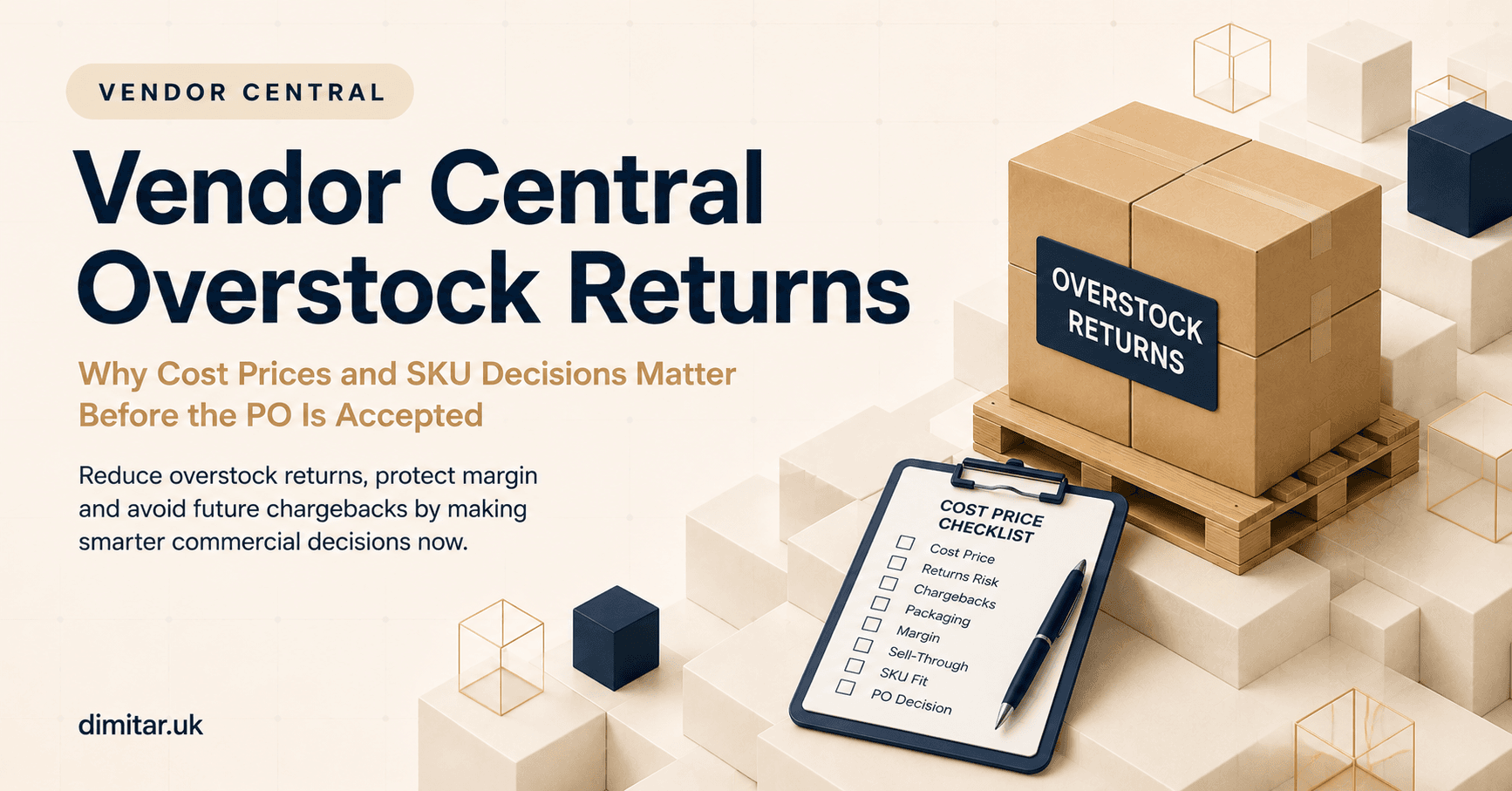
Practical Vendor Checklist
Vendors can reduce overstock return exposure by creating a simple commercial review before high-risk products are supplied.
- Review historic returns by SKU.
- Compare PO value against real margin after deductions.
- Review cost price before accepting high-risk items.
- Identify oversized, slow-moving or seasonal products.
- Monitor overstock returns against new POs.
- Challenge repeat loss-making supply patterns.
- Assess whether Amazon should receive the SKU at all.
- Protect internal teams with clear Amazon supply rules.
The value is in giving teams a practical way to pause before repeating a supply pattern that is already damaging margin.
The Strategic Takeaway
Overstock returns are often a symptom of weak Amazon commercial control, not only a Vendor Central operational issue.
If a vendor only reviews the return after it happens, the business is already working from a reactive position. The stronger approach is to assess product suitability, Amazon cost price, chargeback exposure and PO risk before the stock is supplied.
That does not mean becoming defensive about Amazon. Vendor Central can still be a valuable route for growth, visibility and scale. But it needs enough commercial discipline to separate useful demand from risky volume.
For brand owners, wholesalers, distributors and finance teams, the core question is simple. Is this SKU genuinely worth supplying to Amazon once the full cost of trading is included?
For tailored guidance on Amazon Vendor overstock returns, cost price strategy and chargeback risk, book a consultation.