
Amazon FBA Missing Stock, Why Sellers Must Control the Inbound Shipment Evidence
FBA can be a strong fulfilment option, but sellers must control proof of packing, shipment evidence and inventory movement before Amazon claims stock was not received.
Listen to article
Fulfilment by Amazon can be a very good choice for many sellers. It can support Prime expectations, fulfilment scale, customer service and returns. For small traders, established sellers, brand owners, wholesalers and distributors, FBA can remove a lot of day-to-day fulfilment pressure.
This article is not a general guide to every benefit or drawback of FBA. It is about one specific risk that sellers often underestimate: sending stock into Amazon and later being told that some or all of it was not received.
The mistake is not using FBA. The mistake is using FBA without operational discipline.
The Story That Changed How I Look at FBA Shipments
I once dealt with a case where stock was sent from the UK into Pan-European FBA through an Amazon partnered carrier. The stock was treated as missing internally for years, only for it to be returned more than five years later.
That kind of case changes the way you look at FBA. It shows why sellers should not think only about shipping stock into Amazon, but also about proving what was sent, how it was packed, who collected it, what labels were used and what happened if the system later says the units were not received.
This is not a claim that every shipment will end this way. It is an example of why evidence matters. When stock can move through a large fulfilment network, especially across European fulfilment centres, sellers need a record before, during and after the shipment.
Why Sellers Get Caught Out
Many sellers trust the shipment workflow too much. The shipment is created, labels are printed, the carrier collects, tracking shows movement, and everyone assumes the stock is safely inside Amazon’s system.
That assumption can become expensive.
Sellers often get caught out because they send too much stock without a clear evidence trail. They rely only on courier tracking, do not record carton contents properly, fail to keep clear packing evidence and later struggle when Amazon asks for proof.
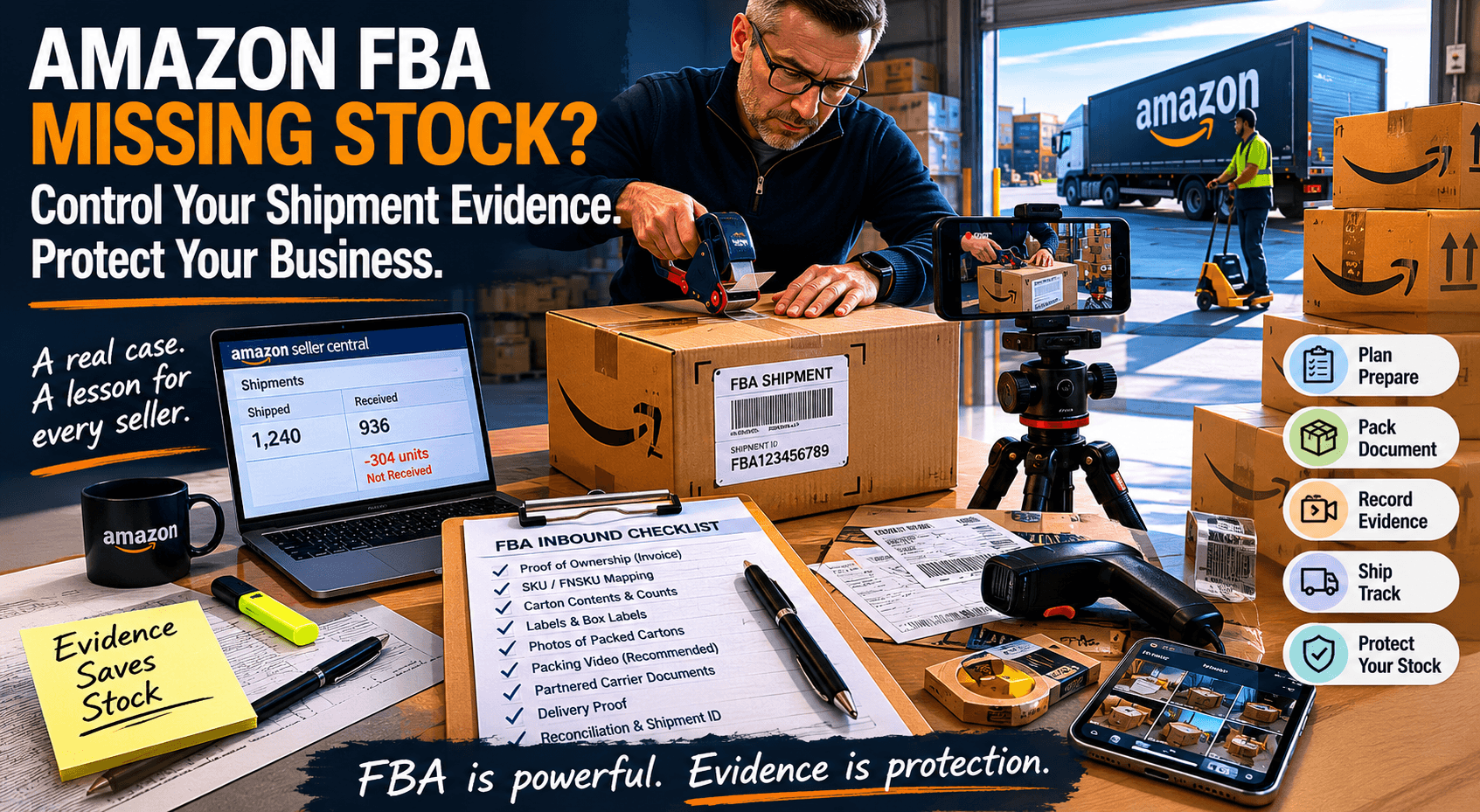
If Amazon says units were not received, the seller may need to show more than a tracking link. They may need proof of ownership, unit quantities, SKU mapping, carton contents, shipment labels, carrier handover and reconciliation evidence.
What Proof Should Exist Before Stock Leaves Your Warehouse
Before stock leaves your warehouse, your evidence file should already be strong. It should not be built later in panic when a shipment enters investigation.
At minimum, I would want to see:
- Supplier invoice or proof of ownership.
- SKU and FNSKU mapping.
- Carton contents.
- Unit count per carton.
- Product labels.
- Shipment ID.
- Box labels.
- Photos of packed cartons.
- Pallet photos where relevant.
- Partnered carrier labels.
- Weight and dimensions.
- Internal packing list.
- Batch or shipment reference.
This does not need to become an overcomplicated process. It needs to be consistent. The aim is to prove what was sent, how it was packed and how the shipment connects to the Amazon record.
Why Video Recording Should Be Treated Seriously
For high-value, high-volume or repeat FBA shipments, sellers should seriously consider recording the packing process. That can include the units being packed, carton sealing, label application and preparation for handover.
The point is not to create cinema footage. The point is to create evidence.
A short, clear video can show the product, quantity, carton condition, box label and packing sequence. If units are later claimed as missing, that evidence may help support a calm and factual case.
This should be proportionate. Not every low-value shipment needs a full recording process. But when stock value, volume or dispute risk is high, video can be useful operational protection.
Partnered Carrier and Delivery Evidence
Amazon partnered carriers can make the inbound process easier, but sellers should still keep their own records. Partnered carrier involvement does not remove the need for evidence control.
Keep booking confirmation, collection proof, tracking events, shipment paperwork, delivery confirmation, pallet paperwork where relevant and any available handover documentation.
Delivery confirmation alone may not prove Amazon received every unit. It is still an important part of the evidence chain. It helps show that the shipment moved through the expected route and reached the relevant delivery stage.
If there is a later discrepancy between shipped and received units, the seller needs to connect the full chain: what was packed, what was handed over, what was delivered and what Amazon recorded.
Be Careful With Large Shipments
Large shipments create larger disputes when something goes wrong. If a seller sends a large quantity without controls, the potential missing stock claim is also larger.
I would be especially careful with new products, new fulfilment routes, new freight patterns, Pan-European placement or high-value stock. In those situations, smaller test shipments can help identify process issues before more stock is exposed.
This is not about being afraid of FBA. It is about matching shipment size to operational confidence.
If the process is not proven, the evidence file is weak or stock value is high, sending a large shipment can create pressure later.
Understand What Permissions You Give Amazon
When using FBA, sellers allow Amazon to store, move, fulfil, return and sometimes dispose of stock according to programme settings and account configuration.
That matters. Sellers should understand fulfilment settings, return settings, removal settings and cross-border inventory settings before sending large quantities into the network.
Pan-European FBA can involve inventory moving across Amazon’s European fulfilment network. That can be commercially useful, but it also makes evidence control more important. If stock moves across multiple fulfilment locations, the seller needs a clear starting record.
Operational control begins before the shipment is collected.
How to Approach a Missing Stock Claim
If Amazon claims stock was not received, do not panic. Start by building the case file.
Compare the shipped quantity against the received quantity. Check the shipment status and reconciliation options. Pull the shipment record, proof of ownership, partnered carrier documents, packing list, carton evidence and any photos or video available.
The case wording should be precise, calm and factual. Avoid emotional language. Do not make claims you cannot evidence. Explain what was shipped, when it was shipped, how it was labelled, how it was collected and what documentation supports the position.
Escalation should be used carefully. It is strongest when the evidence is organised and the discrepancy is clear. There is no guaranteed reimbursement, but a stronger evidence trail gives the seller a better basis for review.
What I Would Prepare Before Using FBA Seriously
For any serious FBA operation, I would create a shipment file for each inbound shipment. That file should be easy to find later, even months after the stock was sent.
The file should include:
- Product invoice.
- Shipment ID.
- FNSKU list.
- Box content list.
- Photos.
- Packing video for important shipments.
- Partnered carrier documents.
- Delivery proof.
- Reconciliation screenshot.
- Case history.
- Internal stock movement record.
This is not only about disputes. It also improves internal discipline. If stock movement is documented properly, teams can understand what happened without relying on memory.
Strategic Takeaway
FBA is not the problem. Poor evidence control is the problem.
The more stock a seller sends into Amazon’s network, the more disciplined the process should become. Sellers should not wait for a missing inventory claim before thinking about proof. By then, the evidence may already be incomplete.
FBA can support growth, Prime eligibility and fulfilment scale, but it should be treated as an operational system that requires control. Sellers still need to prepare, pack, label and send inventory correctly. They also need to prove they did it.
For tailored guidance on Amazon FBA shipment evidence, missing stock claims and Seller Central operational controls, book a consultation.