
Amazon Catalogue Loopholes, When Brand Owners Cannot List Their Own Products
Brand ownership should make Amazon catalogue control easier, but catalogue validation gaps can still prevent legitimate brand owners from listing their own products.
Listen to article
# Amazon Catalogue Loopholes, When Brand Owners Cannot List Their Own Products
Brand owners often assume that once a trademark is registered, GS1 barcodes are in place and Brand Registry is active, Amazon catalogue control should become straightforward.
In reality, it does not always work that way.
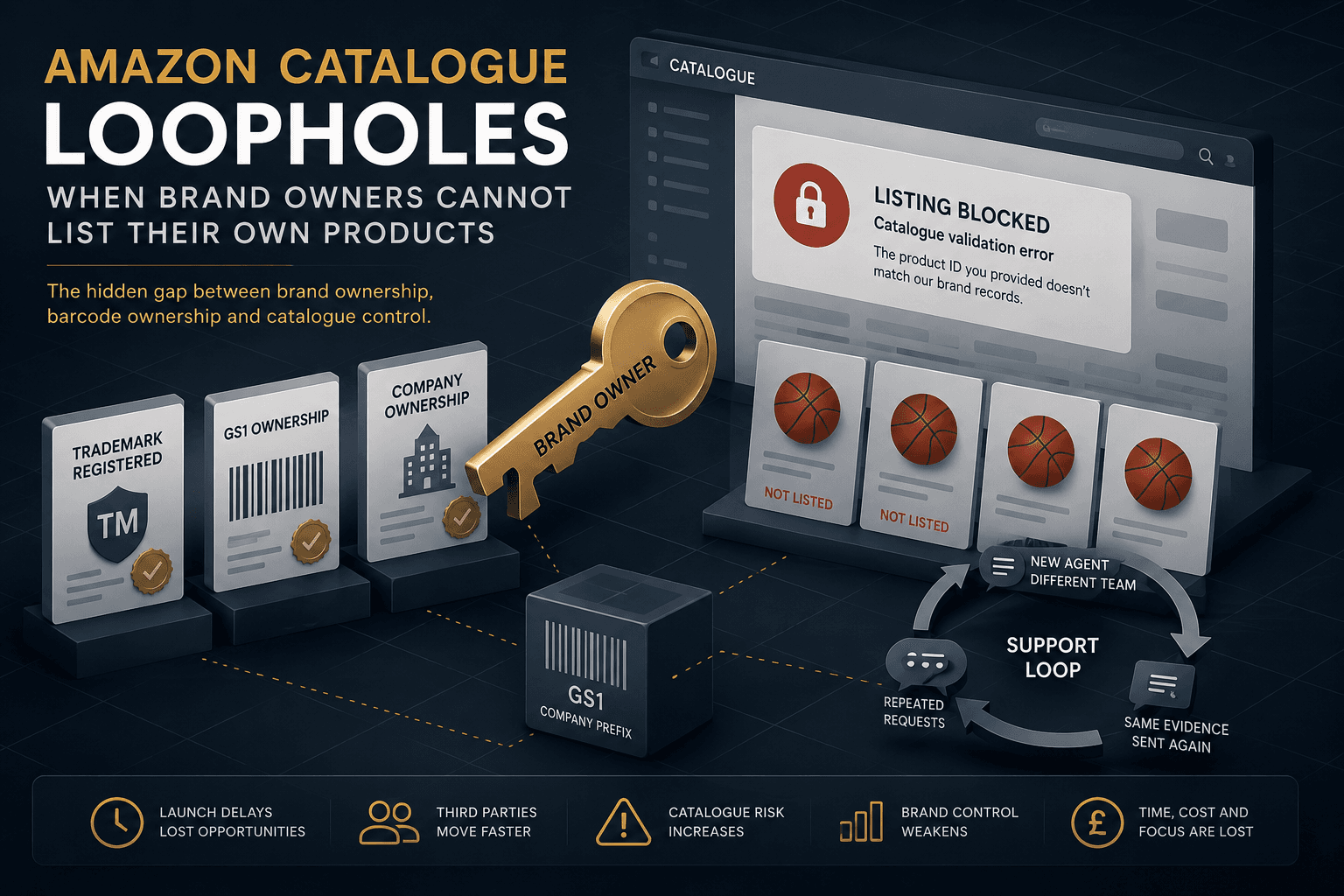
One of the more frustrating catalogue problems appears when a legitimate brand owner is blocked from listing its own products because Amazon’s validation systems do not correctly connect the brand, the barcode owner and the selling or vendor account.
This is more than a technical listing error. It can become a commercial blockage that delays product launches, disrupts range planning and weakens brand control before a product has even reached the customer.
The Hidden Loophole Inside Catalogue Validation
Amazon’s catalogue systems are designed to protect customers and brands from incorrect product data, fake identifiers and unauthorised brand use. In principle, that protection is necessary.
The problem appears when the same protection system fails to recognise the legitimate brand owner.
A brand may have a registered trademark. The same business may own the GS1 company prefix used to create the product barcodes. The same business may also manage the Vendor Central or Seller Central account. Yet the listing can still be blocked because the platform cannot establish the relationship between the brand and the barcode owner inside its own records.
That creates a strange situation.
The brand owner is effectively asked to prove that it has permission from itself.
Why This Matters Commercially
For a brand owner, this is not a small administrative inconvenience.
A blocked listing can delay a launch, hold back a seasonal opportunity, stop a new colour or size from going live, or prevent a product family from being built correctly. If the official brand owner cannot create the listing quickly, another seller may create catalogue content first, often with weaker titles, poor images, incorrect attributes or incomplete product data.
That is where the real risk starts.
Once a poor catalogue contribution enters Amazon’s system, the brand owner may then have to spend time correcting content, recovering brand accuracy and repairing visibility. The original issue may have started as a validation error, but the commercial consequence can be much larger.
When Support Loops Become Part of the Problem
Many brand owners will recognise the support pattern.
A case is opened. Documents are provided. The next reply asks for the same documents again. The case is passed to another team. A new agent reads only part of the history. A template response is sent. The brand owner is told to wait, resubmit, provide another screenshot or send another proof of affiliation.
The problem is not always one person. It is often the structure of the support process.
If the issue is really a catalogue mapping problem, general support replies may not resolve it. They can keep asking for evidence while the actual internal record remains unchanged. The case then becomes a loop, not a resolution route.
Why Evidence Alone May Not Solve the Issue
Brand owners may provide trademark certificates, GS1 certificates, company documents, screenshots, official website links and signed letters. All of these documents may be correct.
But if Amazon’s internal catalogue validation record still does not connect the brand and the GTIN owner, the error can continue.
This is why the request must be specific.
The goal is not simply to review documents. The goal is to correct the brand-to-GTIN mapping so that legitimate products can be listed under the correct registered brand.
Without that correction, support may continue to ask for proof that has already been supplied.
The Wider Risk for Brand Owners
Catalogue control is one of the most underestimated risks on Amazon.
If a brand owner cannot list its own products, several problems can follow. Launches can be delayed. Product families can be fragmented. Third party sellers can move faster than the official brand owner. Incorrect brand attribution can appear. Content quality can suffer. Variation structures can be built badly. Internal teams can lose weeks chasing case replies instead of focusing on growth.
This is why brand protection should not be viewed only as a legal or IP function. It is also an operational and commercial function.
Brand owners need to know that their rights are not just registered. They need to know those rights are recognised correctly inside Amazon’s catalogue systems.
What Brand Owners Should Do
The best approach is to build a clean evidence pack before the issue becomes urgent.
That pack should include trademark evidence, GS1 ownership, company ownership documents, screenshots of the exact error, the exact enrolled brand name, the affected barcode list and a concise explanation of the relationship between the brand owner and GTIN owner.
Even where the brand owner and barcode owner are the same legal entity, a signed confirmation letter can still help. It may feel unnecessary, but it can reduce the chance of the case being pushed back into another proof request.
Where possible, the brand owner should also maintain a public corporate website reference that clearly connects the legal entity, the brand and the product range. This gives support teams something external to validate.
Most importantly, the case wording should ask for the correct action.
The request should not be vague. It should ask for the internal catalogue or brand validation team to correct the brand-to-GTIN mapping for the affected products.
Brand owners should also keep communication factual and concise. Support teams need a clear route through the evidence, not a long emotional account of the frustration. The stronger the evidence pack, the easier it is to explain what needs to be corrected.
The Strategic Takeaway
The real loophole is not only that unauthorised sellers can sometimes influence catalogue data. It is that the official brand owner can still be blocked by the platform’s own validation process when internal records do not align.
That is a serious issue for any brand with active product launches, seasonal ranges or fast-moving marketplace plans.
Amazon catalogue control is not just about uploading content. It is about protecting the route that allows the right content, from the right owner, to enter the catalogue first.
For tailored guidance on Amazon catalogue control, brand validation issues and Vendor Central escalation strategy, book a consultation.