
Amazon Is Translating Product Images: What Brands Should Check
Amazon's image localisation update could make product information easier to understand across 14 stores. Here is where the commercial value lies and what brands should review.
Listen to article
A customer can read your translated title and bullet points, then reach an image that explains the product in a language they do not understand. The information is there, but it is not helping them decide.
Amazon's image localisation update addresses that gap by translating text within eligible product images. For brands selling across several markets, it is a useful development. It also makes the live image experience worth a closer look.
What Amazon has announced
The update covers non-media products across 14 Amazon stores: the US, Canada, Mexico, Brazil, Germany, France, Italy, Spain, the Netherlands, Belgium, Poland, Ireland, Sweden and the UK.
Amazon says translated images can appear on product detail pages and in Image Manager. The main product image is excluded. The AI translation process includes quality checks designed to preserve brand elements, product specifications and visual quality before publication.
There are two situations to understand. Amazon can translate an image that is not in the store's primary language. In selected stores, it also creates versions for a customer's language preference, such as Spanish in the US or French in Canada. Existing imagery in the store's primary language remains unchanged in that second situation.
Why this matters at the point of purchase
Images often carry the information customers use to rule a product in or out: dimensions, fit, materials, compatibility and what is included. If that information is difficult to read, the customer may leave or buy with the wrong expectation.
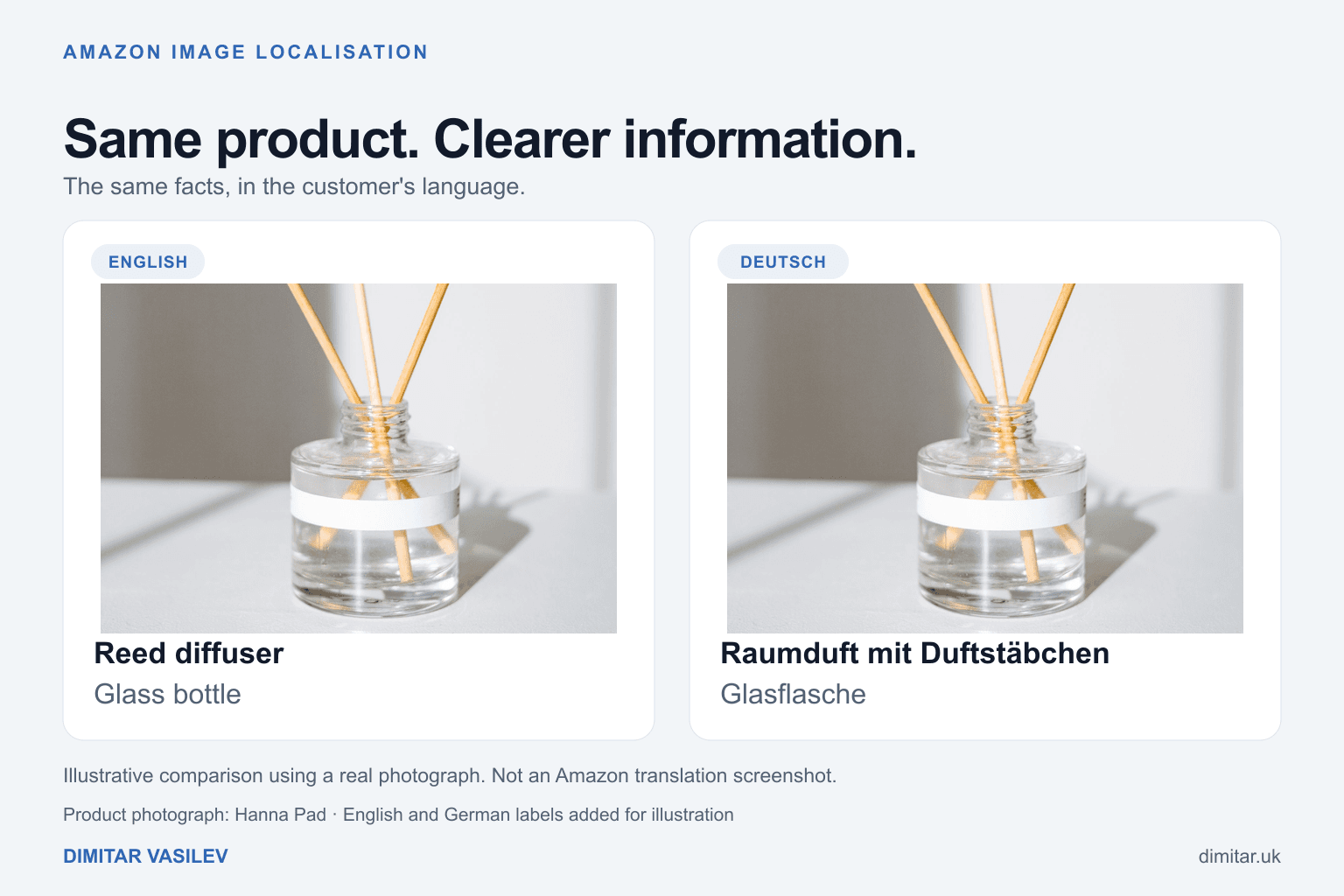
The comparison above uses a real photograph of an unbranded reed diffuser, with its product type and material described in English and German. The customer can understand what is being sold without having to interpret unfamiliar wording. Both panels use the same photograph. This is an editorial example, rather than a screenshot of an Amazon translation.
For Amazon, the stated aim is clearer product information that can help increase sales and reduce returns. For a brand, the commercial opportunity is to remove avoidable uncertainty from the buying decision. An improvement in conversion or returns would still need to be measured; translation alone does not guarantee either.
It could also reduce some repeated creative work when a catalogue spans several markets. That gives brands more room to concentrate specialist localisation on products where precise wording matters most.
The brand still needs to check the result
Amazon describes quality checks covering readability, numbers, units, product information and brand integrity. Those checks are useful, but they do not replace the brand's knowledge of its products.
My starting point would be the ASINs with the most revenue, advertising spend or customer confusion. Review their translated images on the detail page and under View Live images in Image Manager.
Three checks deserve particular attention:
- Does the translated wording describe the right product, variant and included accessories?
- Are measurements, compatibility statements and any important limitations still clear?
- Can a customer read the information comfortably on a mobile screen?
A technically correct translation can still sound unfamiliar to a local customer. For a brand's leading products, natural wording and a clear layout remain worth investing in.
One detail about replacing translations
Amazon's help page draws a distinction that is easy to miss in the announcement.
For a store's primary language, uploading your own correctly localised image through country-specific uploads replaces Amazon's translated version. For a secondary-language version shown according to customer preference, Amazon says to contact support to request removal.
That means a manual upload should not be assumed to remove every language variant. Confirm which version the customer is seeing before choosing the correction route. Vendor Central teams should check the controls available in their own account before following Seller Central instructions.
A sensible response for established brands
This update gives brands a reason to review how their products are understood across markets. Start with a small group of important ASINs, check the images customers actually see and decide where your own localised creative would add value.
Where changes are made, compare conversion and relevant return reasons over time, allowing for price, stock and advertising changes. The useful outcome is a better buying decision, supported by accurate product information.
I advise established brands on Amazon growth, catalogue quality and marketplace expansion. If your image content has fallen behind your international sales, book a consultation to discuss where a focused review would be most valuable.
Sources and image credit
- Amazon's product image translation announcement.
- Amazon's Image localisation guidance. Guidance checked on 23 October 2026.
- Product photograph by Hanna Pad. English and German descriptions added for illustration; no product features have been generated or altered.