
Amazon A+ Content, Why It Matters, And Why It Must Be Created Properly
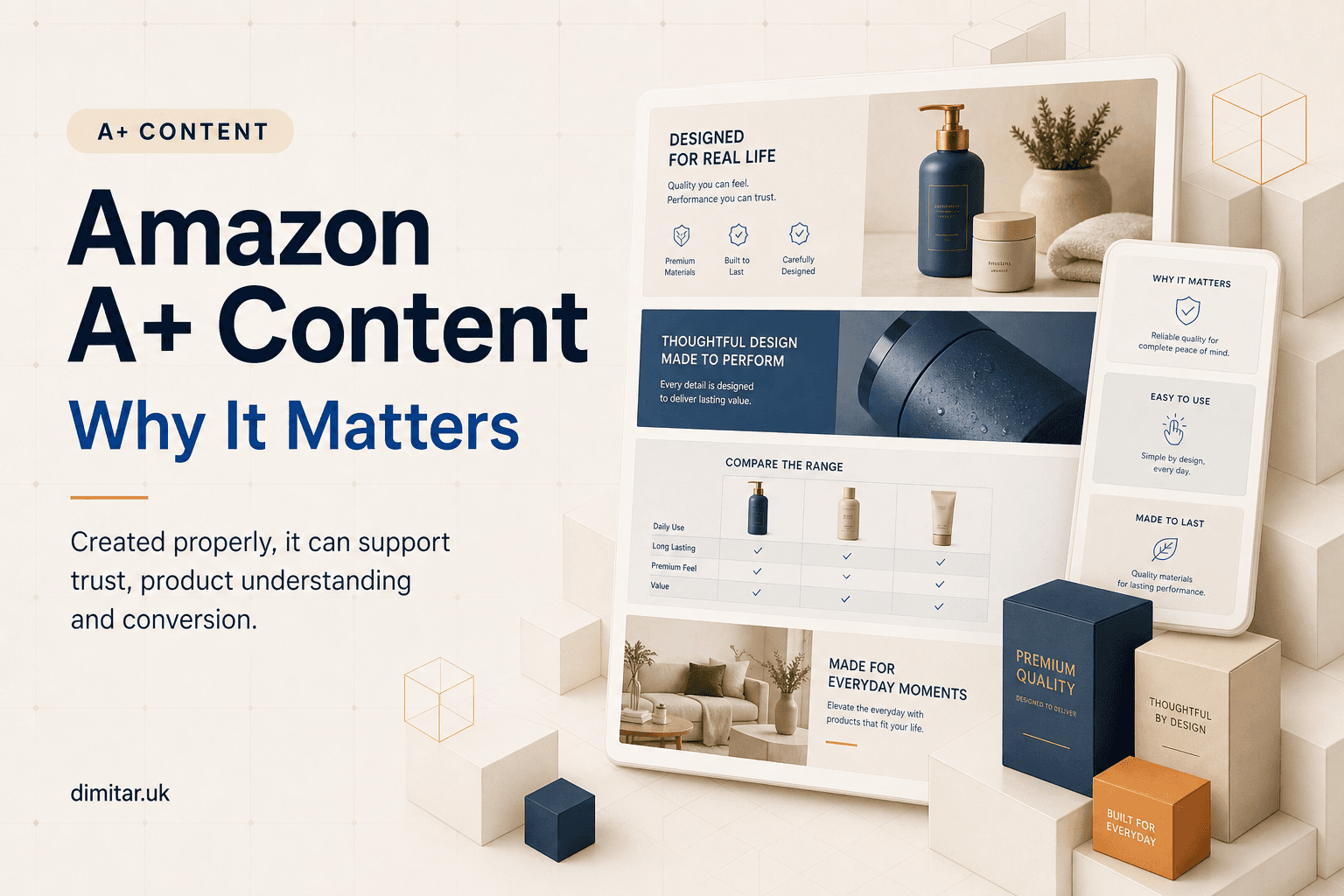
A+ Content can help customers understand a product, trust the brand and make better buying decisions, but only when it is planned with commercial purpose.
Listen to article
Amazon A+ Content is often treated as decoration. A few image blocks, some brand language, a lifestyle banner and the job is considered done.
That is not how I look at it.
A+ Content is one of the most important parts of an Amazon product detail page because it sits at the point where a customer is already interested but may still need confidence. They may like the product. They may understand the price. They may even be close to buying. But they still need enough information to feel that the product is right for them.
This is where good A+ Content can help. It can explain features, show use cases, support the brand story, compare products and reduce uncertainty. It can also make the product feel more credible when a customer is choosing between similar listings.
Amazon states that Basic A+ Content can help increase sales by up to 8%, and that well implemented Premium A+ Content can help increase sales by up to 20%. Those figures should not be treated as a guarantee, but they do show why A+ Content deserves serious commercial attention.
Customers Need More Than a Title and Bullets
Titles, bullets and images are important, but they do not always give customers enough context. A product title may carry keywords and essential information. Bullet points may cover features. Images may show the product from different angles.
That still leaves gaps.
Customers often want to understand how the product fits into their life, how it compares with alternatives, what makes it different and whether the brand looks trustworthy. They may need to see scale, use cases, material detail, compatibility, care instructions, range structure or feature comparisons.
A+ Content gives brands more space to answer those questions in a visual and structured way.
This matters even more on mobile, where customers scroll quickly and may not read every bullet point carefully. Strong A+ Content can make key information easier to absorb, especially when the modules are planned around the customer journey rather than simply filled with design assets.
A+ Content Can Support Trust and Conversion
Good A+ Content helps customers make a decision with more confidence. It can show the product in use, explain feature benefits, introduce the brand, clarify technical details and guide customers towards the right option in the range.
Comparison charts can be useful where a customer needs to choose between sizes, models, colours or related products. Lifestyle modules can help customers understand the product in context. Feature-led modules can reduce uncertainty around materials, fit, dimensions, performance or usage.
Brand story content can also matter. Customers may not know the business behind the product. A clean, credible brand section can help show that the listing is not just another anonymous marketplace offer.
This is not about making the page pretty. It is about improving the quality of the buying decision.
When A+ Content sets better expectations, it may also help reduce negative reviews. If customers understand the product more clearly before buying, there is less room for disappointment caused by unclear information, weak images or missing context.
Poor A+ Content Can Underperform
Not all A+ Content is useful. Some of it wastes space.
Poor A+ Content often repeats the same weak claims already used in the bullets. It may use large lifestyle images without explaining anything meaningful. It may look like generic marketing rather than useful product communication. In some cases, it creates more confusion because the customer has to work harder to understand what actually matters.
That is a problem because the product page has limited attention. Every section should earn its place.
If A+ Content is difficult to read on mobile, too vague, visually cluttered or disconnected from the product’s real selling points, it may not support conversion. It can make the brand look less controlled, especially where the images, tone and product information feel inconsistent with the rest of the listing.
The risk is not only that weak A+ Content fails to help. The risk is that it gives the customer another reason to hesitate.
It Needs Commercial Planning, Not Just Design
A+ Content should not begin with the question, “What can we make this look like?”
It should begin with better questions:
- What does the customer need to understand before buying?
- What objections may stop the sale?
- Which features need visual explanation?
- What makes this product different from the alternatives?
- Which products should be compared within the range?
- What information is most important on mobile?
- What does the brand need to communicate clearly?
Design matters, but design without commercial thinking is not enough.
For Vendor Central teams, Seller Central brand managers, wholesalers and distributors, A+ Content should be connected to the listing’s commercial purpose. Is the goal to improve conversion on an existing product? Support a launch? Explain a technical product? Build trust in a premium price point? Help customers choose between variations? Reduce avoidable returns or poor reviews?
The answer should shape the content.
Mobile Readability Matters
A+ Content must work on mobile. Many customers will not see the desktop version first. If the text is too small, images are overloaded or the message depends on a large screen, the content may fail where it matters most.
Mobile readability is not only a design issue. It is a commercial issue. Customers should be able to understand the key points quickly, without zooming, guessing or scrolling through decorative modules that do not answer their questions.
This is why A+ Content needs structure. The strongest modules usually have a clear job. One may explain the product range. Another may show feature benefits. Another may answer a practical usage question. Another may introduce the brand. Together, they should help the customer move closer to a buying decision.
The Strategic View
A+ Content is valuable because it gives brands more control over how products are understood. It can support conversion, strengthen trust, improve product comparison and reduce uncertainty.
But it has to be created properly.
It should not be generic. It should not simply repeat the listing. It should not be a design exercise disconnected from customer behaviour. It should help the customer understand the product better than they did before.
For brands that want their A+ Content to support conversion rather than simply fill space, this is an area where I can help.